
Zaina Erhaim reported from the battlefields of the Syrian civil war. Today, she’s helping the next generation of women journalists stand up and speak out across Syria and the region.
One year ago, the world watched in shock as the Syrian civil war came to a sudden—if uneasy—end.
The stunning collapse of Bashar al-Assad’s tyrannical regime made front-page news across the globe. Foreign correspondents caught last-minute flights to Damascus, racing for scoops and exclusives. Their breathless reporting from inside Assad’s ransacked residence and the emptied cells of Sednaya prison led the evening news.
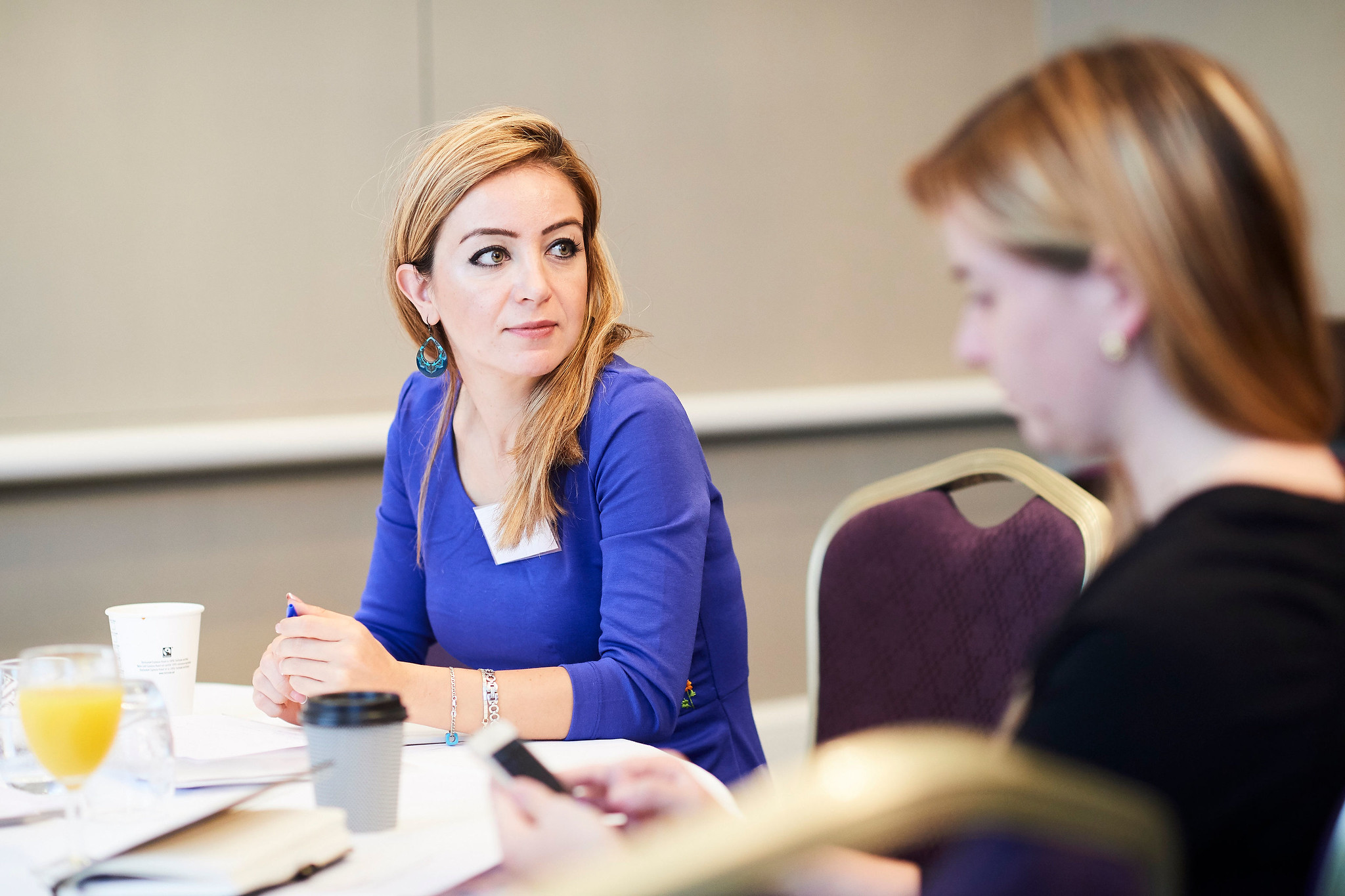
But for Zaina Erhaim—an award-winning Syrian journalist and the founder of grantee partner Shams for Equity and Social Justice (SHAMS)—Assad’s downfall wasn’t just a headline. It was the start of a new chapter.
Last month in Damascus, SHAMS officially launched its newest initiative: the Women Journalists Alliance. Led by Zaina, with support from the Fund for Global Human Rights, it’s the latest venture in her lifelong work uplifting women’s voices.
From War Reporter to Refugee
Born in Syria, Zaina learned to disassemble Kalashnikov rifles during military training and to quote Bashar al-Assad’s father, Hafez, by heart in her journalism classes at Damascus University. She was the first woman journalist from her hometown of Idlib, she told On the Media in a 2017 interview.
When the Syrian civil war broke out in 2011, Zaina was working for the BBC in London. As the conflict spread, she returned to Syria, reporting from the front lines in Raqqa, Latakia, eastern Aleppo, and her home in Idlib.
With support from the Institute for War and Peace Reporting (IWPR), she launched a training program for citizen journalists. Noticing that most of the participants were men—who, unlike women, did not need family permission to travel—she started offering sessions specifically for women.
By 2015, Zaina had trained about 100 new journalists, a third of them women. She created a dedicated women’s blog, elevating their voices and showcasing stories that had been overlooked.
“For most men, for most male media activists, the news is how many barrel bombs have hit, [which military faction has] captured this area, how many people are killed, how many are injured?” she told On the Media. “The women are writing about life, not war, the story of Syria, not the story of the Syrian conflict.”
Zaina’s fierce feminism and dogged commitment to independent journalism earned her international awards and accolades. But it also made her a target in Idlib, where the Islamist rebel group Hay’at Tahrir al-Sham (HTS) was growing more extreme.
As HTS embraced more restrictive policies, life became harder for women in northwest Syria. The de facto authorities required Zaina to dress in a hijab with a long, dark coat. Whenever she left the house, she had to be accompanied by a male “guardian.” Finally, facing credible threats to her life, she made the difficult decision in 2015 to seek safety in Turkey and then the United Kingdom, where she was granted asylum.
From London, Zaina founded SHAMS, an organization dedicated to promoting and protecting women’s rights in Syria and the wider West Asia and North Africa region. She continued to write powerfully about the rights of women and girls. But she never thought she would return to Syria again.
Then, last December, her phone rang in the middle of the night. It was her mother: Assad had fallen. After ten years in exile, Zaina could go home.
Between Autocracy and Patriarchy
Syria today stands precariously on the road toward lasting peace. The war is over, but sporadic outbursts of sectarian violence continue to roil the country. The new government, led by former HTS commander Ahmed al-Sharaa and dominated by former HTS figures, has courted international legitimacy and investment. But it has also delayed promised democratic reforms and maintained security through force.
In this fragile environment, the importance of independent journalism is more than just lip service toward democratic ideals. A free press is a platform for marginalized voices, an archive of their lived experiences, and a vehicle for community-led peacebuilding and justice. Perhaps most importantly, it is a vital source for truth in an ocean of disinformation and propaganda.
As civil society begins to rebuild and reorganize, dissent remains dangerous. Official narratives are tightly controlled by the state, and freedom of the press is limited. In Reporters Without Borders’ annual press freedom index of 180 countries, Syria moved up two spots this year—from 179 to 177.
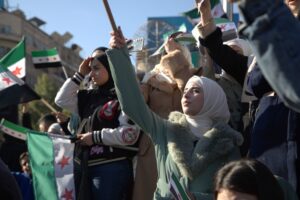
Women journalists especially continue to face persistent challenges to their personal freedoms and professional development. These include state-imposed restrictions on press freedom, gender-based discrimination, and deeply rooted misogyny—issues that impact women journalists across the region.
These risks are magnified in conflict or post-conflict areas, and in countries under Islamist governance. A recent survey by Reporters Without Borders and the Afghan Independent Journalists Foundation found that 80 percent of women journalists have lost their jobs since the Taliban takeover. Syrian journalist Ruda Asad has written that when she sought media credentials from the Ministry of Information, she received just a three-day permit.
According to a survey by the International Center for Journalists, 30 percent of women journalists self-censor on social media due to harassment and threats. Another survey found that 20 percent stopped online interaction entirely.
“It took me years to accept that being an independent journalist and human rights defender means I will be hated and attacked and will face violence both online and offline,” Zaina wrote in a 2023 article for the Wilson Center. “That doesn’t mean I accept it as a matter of fact, but rather must be resilient to misinformation and its effect on my wellbeing and confidence.”
A Free—and Feminist—Press
Zaina’s experience navigating these complex challenges inspired her to create the Women Journalists Alliance (WJA)—a new initiative dedicated to protecting, promoting, and empowering Arabic-speaking women in the media. Co-founded with journalists Basma Mostafa and Manar Al-Zubaidi, the collective’s current membership includes 30 women, half of whom are from Syria.
With support from the Fund for Global Human Rights, the WJA is expanding on Zaina’s earlier efforts to train and mentor women journalists during the war. It is a hub for professional development and collaboration, offering workshops, networking opportunities, and leadership training. Crucially, it’s also a space for support, solidarity, and feminist organizing.

At WJA-hosted workshops this summer in Damascus and Latakia, participants learned how to develop investigative hypotheses, identify sources, and verify information. But along with skills-building sessions, the trainings held space for conversations about sectarianism, identity, and empathy.
“The woman’s perspective is much more into a human rights approach [sic] because they are more able to see the hierarchy of oppression and focus on the most marginalized groups,” Zaina told Women in Journalism in an interview.
Regardless of the pervasive risks, women journalists across West Asia and North Africa refuse to be erased. From Syria and Palestine to Yemen and Iraq, they continue to be powerful truth-tellers and advocates for justice, equity, and human rights. Their bold reporting is a necessary corrective to entrenched patriarchy and authoritarian politics.
Writing Their Own Future
When the Fund for Global Human Rights began quietly supporting civil society in Syria in 2021, the country had experienced decades of dictatorship and conflict. The vast majority of human rights defenders had been killed or exiled. But their story wasn’t finished.
As one of the few international funders working in Syria at the time, we aimed to seed a new generation of grassroots activism by supporting initially disparate groups and gradually connecting them into a cohesive movement with collective power. Today, those activists—like Zaina—are working together to shape their country’s future.
Enabled by our community of donors and allies, we provided start-up funding for SHAMS to launch the WJA. With this support, women in Syria—and throughout the region—can continue to shine a light on abuse and advocate for peace, justice, and human rights.
Their courage and commitment—grounded in lived experience—kept the world informed through the darkest days of the Syrian civil war. Just as quickly as foreign correspondents parachuted in to report on the chemical attacks in Ghouta or the fall of ISIS, they left again—chasing the next big story somewhere else. But throughout the conflict, local media kept their cameras rolling. Women, despite the danger, kept reporting.
From the war-ravaged squares of Aleppo and Homs to the streets of Damascus today, they have shared the true story of Syria: not as a proving ground for geopolitical power projection, but as a nation of people with enduring hope for their future.
These women don’t need their story told by foreign correspondents. Because they’re writing it themselves.
Zaina’s courage and commitment is opening doors in Syria and beyond. Donate today to support activists like her creating powerful change around the world. Your gift will be matched, doubling your impact.