

Community organizing in the streets of Minneapolis shows what solidarity looks like at scale. David Mattingly shares four things activists everywhere can learn from the movement in Minnesota.
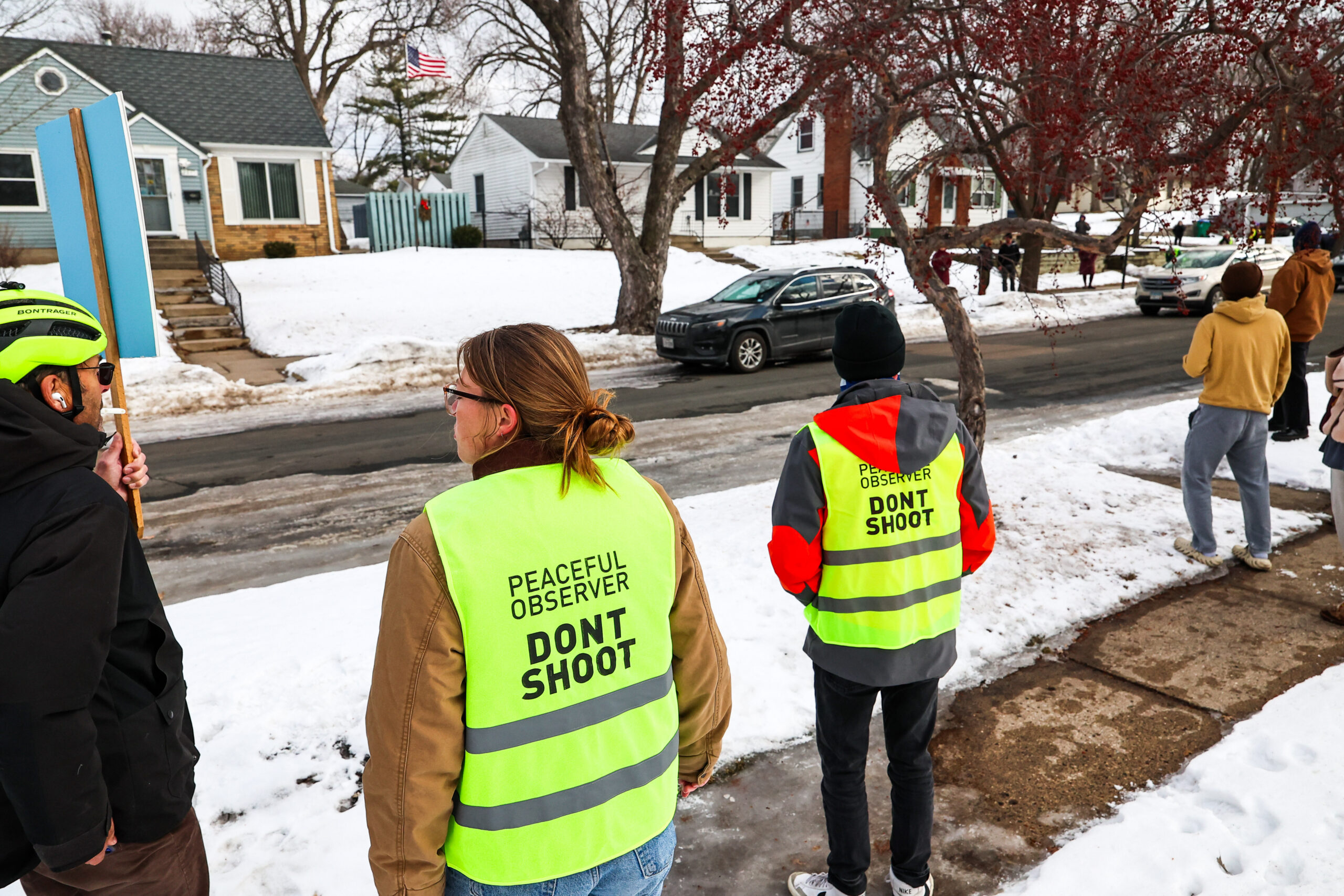
In recent weeks, the world’s eyes have been on Minneapolis, where community opposition to violent immigration raids has mobilized large-scale protests and influenced political winds.
In this piece, I explore what activists everywhere can learn from the movement in Minnesota.
1. Local organizers—not national organizations—are leading the efforts.
Groups and people who share physical proximity and/or lived experience with their communities are often best placed to develop solutions when challenges arise. In Minneapolis, frontline groups have spent months and years building constituencies, programs, and practices—relying on their deep local knowledge and community roots to motivate and mobilize in response to threats of oppression.
According to local activists, nearly 5 percent of every neighborhood in the Twin Cities is part of a Signal chat—an estimated 12,000 people. Local groups have trained tens of thousands of legal observers to document abuses. Mutual aid groups have stepped up to support struggling families. Restaurants have offered free food and warm beverages to people mobilizing outside in sub-zero temperatures.
This is what community-based organizing looks like at scale.
Human rights activism is often seen as synonymous with protesting. Demonstrations are, undoubtedly, an important tactic. But successful movements for social justice encompass an entire spectrum of activism, from rapid response communications to readily available legal aid. This infrastructure doesn’t materialize overnight—it is the product of patient, dedicated community organizing.
2. Their movement is a big tent with room to grow.
Local organizers in Minneapolis aren’t only serving their established constituencies. They have built the foundations for an expansive coalition with room for diverse people and groups. Now, amid a groundswell of support, they have been able to mobilize more rapidly and scale more effectively.
Despite the usual accusations of paid protesters and outside agitators, the movement that has emerged in Minneapolis is an organic coalition that cuts across issues—from faith groups practicing the teachings of scripture to organized labor wielding economic leverage.
On the surface, it can seem that business leaders and mutual aid groups have little in common. Yet protecting community safety and upholding the rule of law are values shared by a wide group of actors. Local activists have been incredibly effective at communicating these shared values to a broad coalition and wider group of supporters.
Movements for change are strongest when they are broad-based and intersectional. This is a lesson borne out time and time again throughout the history of social justice. Change is nearly never created by a single person or organization—it is the product of an ecosystem that connects issues, geographies, and generations in a movement to transform the status quo.
3. The movement in Minneapolis has a powerful narrative.
By broadening their coalition, activists and organizers have eschewed easy labels and undermined the toxic smears usually used to diminish human rights defenders. Instead, the display of unity undergirds a narrative built on shared values that has resonated not just locally but nationally.
This narrative, critically, connects individual actions to systemic repression. People across the country are able to see that the overarching problem and source of repression is institutional—in this case, ICE—rather than the individual actions of bad actors. Individual accountability for those who directly commit abuses is important to restore the rule of law, but so is remedy provided by the government. These are core human rights principles.
Anti-rights actors often harness fear, anger, or hatred to push their agenda. These are undoubtedly powerful emotions. But solidarity, care, and safety—in practice, not just principle—are proving to be effective antidotes. What may have started as a reaction founded in fear and anger has catalyzed a truly rights-based response, one that is not simply proselytizing but demonstrating the power of human rights.
4. Grassroots activism is driving legal and political strategies—not the other way around.
Where top-down advocacy has failed to stave off abuses, community organizing is succeeding. And in response, national legal and political groups are adapting their strategies to harness this momentum and apply similar pressure at the institutional level. Other states are enacting legislation to prevent abuses in their streets. Legal groups are filing federal suits seeking wider injunctions against repressive tactics.
That is a bedrock on which systemic change can be built.
In the United States and across the world, democracy is in decline, with governments promising to deliver stability and order by cracking down on protest and scapegoating marginalized groups such as migrants. However, in many cases, states have used their monopoly on violence to become agents of instability themselves, until the cracks of their broken promises become irrefutable.
In sharp contrast, local civil society has shown that community organizing offers a different kind of stability and security—one rooted in solidarity and shared values. Human rights defenders everywhere can use these foundations to resist the criminalization of solidarity anywhere.

David Mattingly is vice president for programs at the Fund for Global Human Rights.
Sign up to our newsletter
Add some impact to your inbox.
By submitting this form, you accept that your data will be stored and processed in line with our Privacy Policy.